

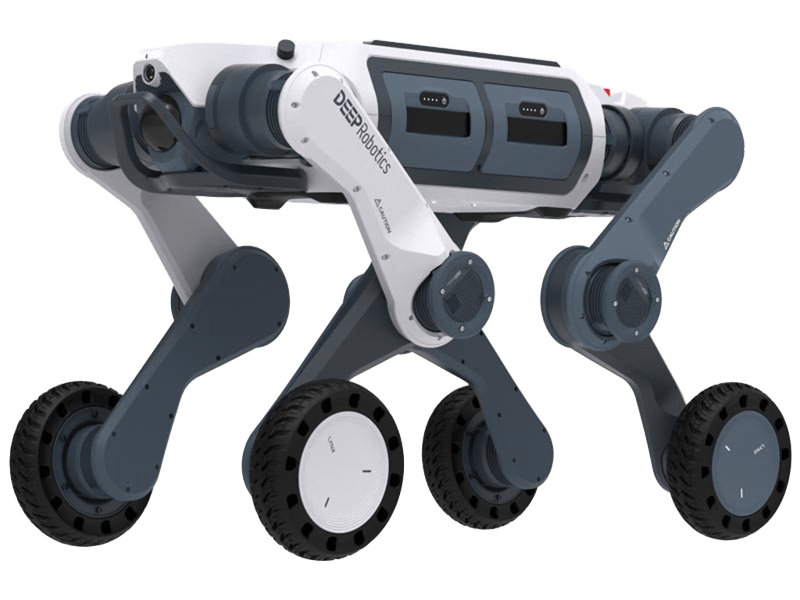
DEEP Robotics LYNX M20S
- Back payload
- 35 kg
- Unloaded runtime
- 3.5–5 h
- Operating speed
- 2 m/s


Price on request · Available to order
DEEP Robotics Lite3 LIDAR is a quadruped platform for perception research, motion programming and mobile application development. The Lite3L configuration includes following, obstacle avoidance and automatic navigation functions. It suits a laboratory studying the relationship between observation of the surroundings, selection of a goal and the robot's physical movement.
The lidar-equipped version supports experiments built around reaching a selected location. A team defines a route or goal and observes how the robot uses available perception and responds to objects along the way. Application software can connect arrival with another action, such as recording from a fitted instrument. The experiment's purpose and task logic define the useful work, with the robot supplying the mobile foundation.
The Lite3L function set also lists front and rear obstacle stopping, object following and obstacle avoidance. These modes let students compare ways of requesting movement. Following relates the goal to a moving object, while a navigation scenario relates it to a location. That distinction shows how the same physical mechanism can serve different software tasks when the relationship between sensing and goals changes.
A URDF model, SDK, APIs and perception-development interfaces are provided for development. The model describes the robot's kinematics in a software environment, and the interfaces connect custom code to the physical platform. Research can begin with the mechanism and available data, then progress to an action sequence and its behaviour on a selected surface.
Moving from a software model to the real machine involves foot contact and body movement. An industrial inertial module contributes information to the control system, while physical conditions influence how an algorithm performs. A repeatable experiment helps relate calculation to observation: run the same task with changed parameters and examine the resulting difference in movement.
USB, HDMI and Ethernet provide connections for computing and peripheral equipment. A modular architecture supports projects with additional sensors and processing modules. Those additions can serve custom perception development, with the chosen module and its software matched to the research question. Their mass and placement become part of the complete robot configuration.
A Lite3L payload includes mounting hardware, cables and the power demand of added devices. Sensor views and leg clearance need to remain usable after equipment is fitted. Runtime and travel distance depend on the version and activity. Longer studies can be arranged as separate sessions with service intervals, helping keep the hardware conditions consistent when comparing algorithm results.
Lite3L has its own equipment arrangement within the Lite3 family. For a UAE teaching or research team, it supports progression from prepared movement to an application using perception: receive data, set a goal, examine the response to an obstacle and relate the result to physical behaviour. This makes mobile robotics programming an observable engineering process with a real mechanism, rather than only a software demonstration.

Tell us about your task, site and robot. Leave your contact details so we can discuss the scope and next steps.