

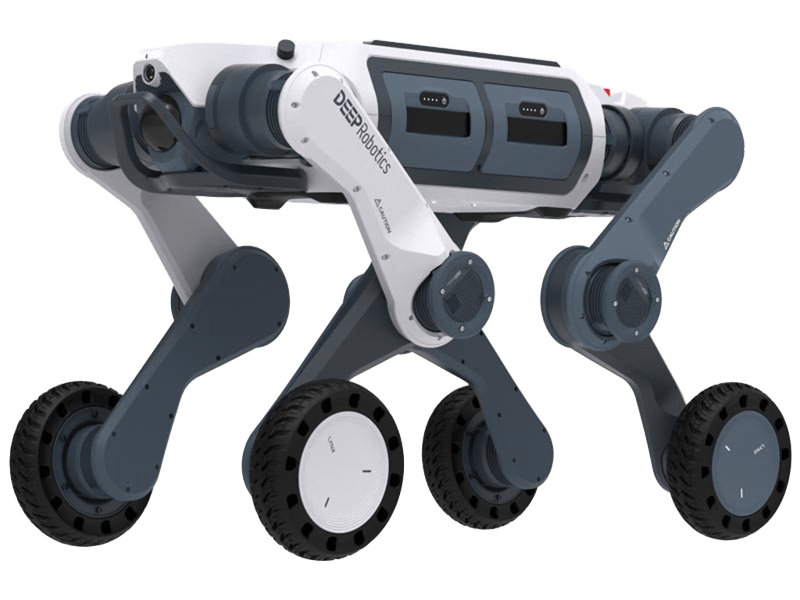
DEEP Robotics LYNX M20S
- Back payload
- 35 kg
- Unloaded runtime
- 3.5–5 h
- Operating speed
- 2 m/s



Price on request · Available to order
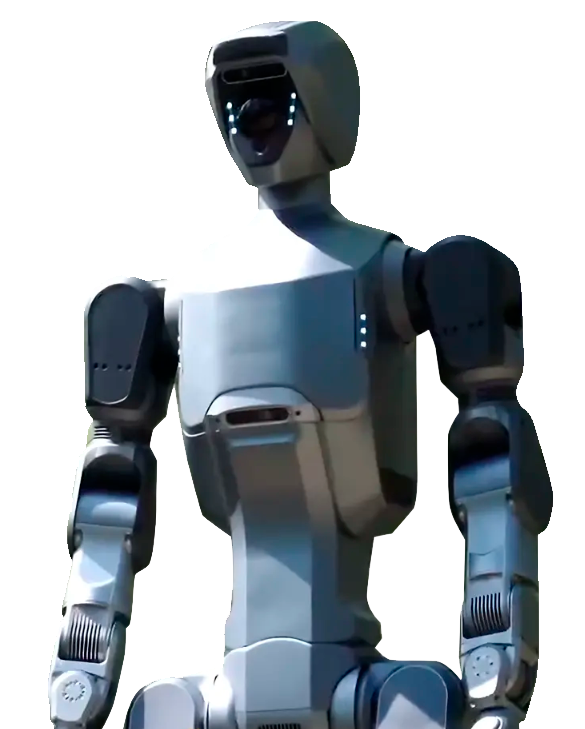
DEEP Robotics DR02 is a full-size humanoid platform for motion development and research into tasks combining walking with arm movement. The standard version has two legs, two arms and an articulated waist. It is intended for engineering work with physical mechanisms: a team defines movements, observes the response and develops an application through the available interfaces.
Each leg of the standard DR02 has six degrees of freedom, allowing changes in foot position and body posture during movement. A research workflow can examine the relationship between the support sequence, the contact surface and balance. Experiments can progress from individual postures to transitions between them, studying the behaviour of the whole robot rather than only one actuator in isolation.
The articulated waist contributes to the overall movement arrangement. When preparing an operation, the team considers arm trajectories together with the position of the body relative to a working surface. For a walking manipulator, access to an object depends on both posture and the chosen stopping point. DR02 therefore offers a basis for investigating how locomotion and upper-body action can be connected in one sequence.
Each standard-version arm has four degrees of freedom before the end effector. Dexterous hands are not included in this configuration. Object-handling research must therefore be designed around the selected tool and the available arm kinematics. Gripping method follows the object, while the action sequence follows the robot's position beside a table or another working area.
The manufacturer's dual-arm payload figure applies to the combined arms and must be considered alongside motion and tool arrangement. Development needs to define which mechanism receives the object, where its trajectory passes and how the action ends. These are application design choices rather than a complete handling process supplied simply by the presence of two arms.
The standard DR02 includes a lidar, a wide-angle camera and an industrial eight-core processor. These components form part of the platform hardware. Motion-development support lets a team create its own sequences, while Gigabit Ethernet connects the robot to an external system. The power needs of additional equipment must suit the provided electrical interface.
The family also includes DR02 Pro with different arm kinematics and additional perception equipment. A standard-version application should follow the movement and interfaces available on that version. The manufacturer identifies SLAM mapping, navigation and voice interaction as future OTA functions. Current development therefore needs to rely on the functions already present in the selected software release.
A modular quick-disassembly design supports work with individual components, and a replaceable battery helps organise consecutive experimental sessions. The IP66 rating applies within the manufacturer's conditions rather than specifying a universal environment for every experiment. For a UAE robotics laboratory, DR02 is a full-size humanoid foundation on which the team defines its working motions, end effector and application software.


Tell us about your task, site and robot. Leave your contact details so we can discuss the scope and next steps.