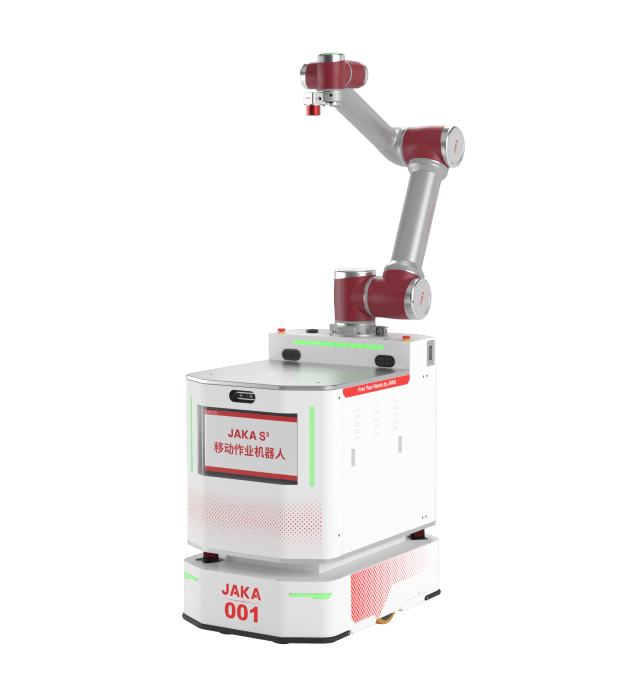
Model
- Model
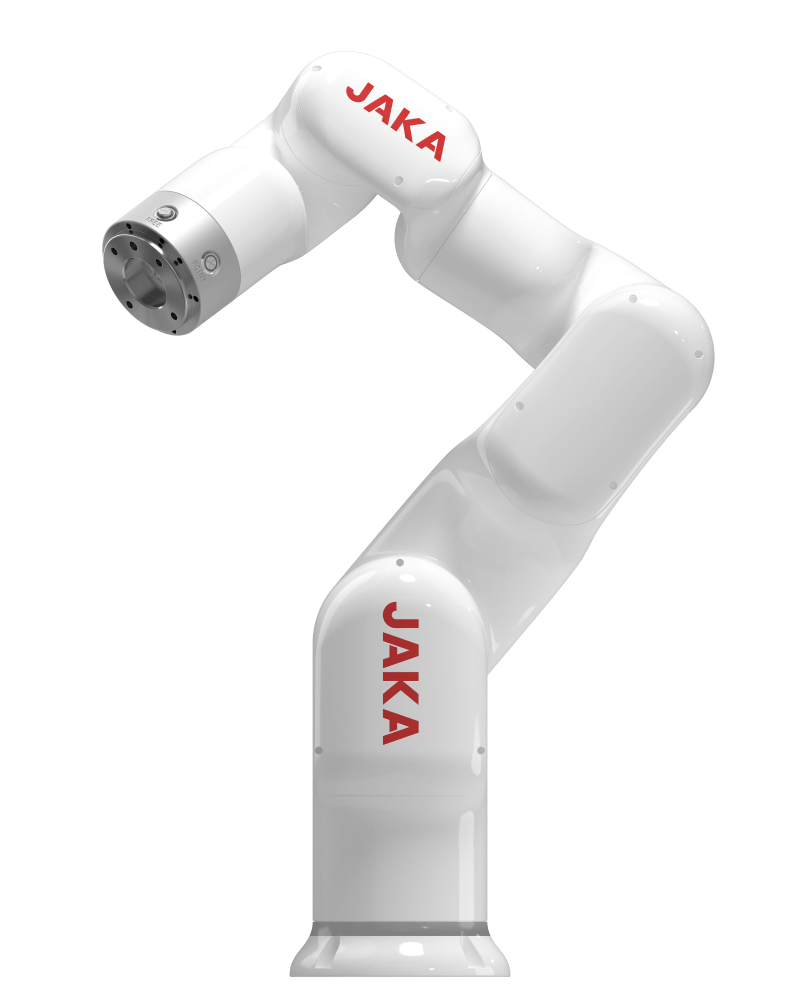
- JAKA Mini2
- Country of origin
- China
Arm
- Rated payload
- 2 kgPermitted load depends on centre-of-gravity offset from the flange.
- Weight including cables
- 9.9 kg
- Reach
- 58 cm
- Axes
- 6
- Programming
- Graphical, hand-guided
- Operator devices
- PC, tablet, smartphone
- Average consumption
- 180 W
- Operating temperature
- 0–50 °C
- Operating humidity
- 0–90 % RHNon-condensing.
- Body protection
- IP40
- Mounting
- Any orientation
- Materials
- Aluminium alloy, PC
- Base diameter
- 12.4 cm
Joints
- J1: range
- ±360 °
- J2: range
- ±125 °
- J3: range
- ±130 °
- J4: range
- ±360 °
- J5: range
- ±120 °
- J6: range
- ±360 °
Tool
- Typical TCP speed
- 1 m/s
- Digital inputs
- 2 channels
- Digital outputs
- 2 channels
- Analogue inputs
- 2 channels
- Connector
- M8
- I/O supply
- 12/24 V DCSwitchable in the App; the current product table specifies 24 V mode.
- Continuous supply current
- 1 A
- Peak supply current
- 2 APeak duration is not stated.
- Digital input mode
- Sink / SourceConfigurable in the App.
- Digital output mode
- Sink / Source / Push-pull
- Maximum DO current
- 1 A
- Analogue input range
- 0–10 V
- RS485
- 2 channelsMultiplexed with DO1/DO2 and AI1/AI2; not additional independent I/O.
Controller MiniCab
- Model
- MiniCab
- Weight
- 1.1 kgCabinet itself; accessory weight is not included.
- Protection
- IP20
- Materials
- Steel, aluminium alloy
- Operating temperature
- 0–50 °C
- Rated supply
- 48 V DC
- I/O supply
- 24 V DCWhen both VP+ and VL+ are below 26 V, UDIO_24V output is below 24 V.
- Digital I/O
- 7 channelsMultiplexed NPN inputs/outputs; one mode per channel at a time.
- Digital output current
- ≤1 A
- User connector supply
- 24 VBuilt-in 2.7 A overcurrent protection; voltage depends on input supply.
- RS485
- Master / SlaveTwo external-device interfaces: master and slave.
- LAN1
- 10/100 Mbit/s
- LAN2
- 10/100/1000 Mbit/s
- Wireless connection
- Wi-Fi 2.4 GHz
- Protocols
- TCP/IP, Modbus TCP, Modbus RTU, PROFINET, EtherNet/IP
- Mounting
- Panel / guide railRail mounting accessory is purchased separately.
- Remote power on/off
- Digital inputsExternal momentary switch; wiring according to the manual.
MiniCab IPC
- CPU
- Intel Celeron J1900, 1.99 GHz
- RAM
- DDR3L 2GManufacturer capacity notation.
- Drive
- 64GDrive technology is not specified.
- USB
- 1×USB 3.0, 1×USB 2.0Internal debugging only; use requires contacting JAKA technicians.
- HDMI
- 1 portInternal debugging only; use requires contacting JAKA technicians.
Cables
- Robot cable installation
- FixedNot suitable for a cable carrier; a flexible option requires separate agreement.
- Outer diameter
- 7.1 mm
- Minimum bend radius
- 42.6 mm
- Control stick cable
- 6 m
Power adapter
- Model
- HRP-300N3-48, MW
- Output voltage
- 48 V DC
- Rated current
- 7 A
- Current range
- 0–7 A
- Rated maximum power
- 336 W
- Maximum ripple and noise
- 250 mV p-p
- Voltage accuracy
- ±3 %
- Line regulation
- ±1 %
- Load regulation
- ±3 %
Recommended conditions
- Recommended robot supply
- 40–56 V DC
- Maximum RMS current
- 3.75 A
- Peak current
- 12.5 APeak current depends on operating state and mode.
- Altitude in typical column
- 1000 mIn the recommended-conditions table; an altitude limit is not specified.
- Recommended humidity
- 10–90 % RHNon-condensing.
- Warm-up
- At ambient temperature <10 °C
Robot power
- Peak power
- 672 WLoad and application dependent; maximum, not average consumption.
Cabinet power
- Typical consumption
- 12 W
- Maximum consumption
- ≤30 W
Power
- Separate inputs
- Cabinet VL+, robot VP+VP+ can also power the cabinet; separate robot power disconnection is supported.
Complete set
- Robot
- 1 pcWhen purchasing a complete set.
- MiniCab cabinet
- 1 pcWhen purchasing a complete set.
- Control stick
- 1 pcWhen purchasing a complete set.
- 48 V DC adapter
- 1 pcWhen purchasing a complete set.
- Cabinet power cord
- 1 pcWhen purchasing a complete set.
- Robot connection cable
- 1 pcWhen purchasing a complete set.
- Product qualified certificate
- 1 pcWhen purchasing a complete set.
- Quick start guide
- 1 pcWhen purchasing a complete set.
- After-sales warranty card
- 1 pcWhen purchasing a complete set.
Operation
- Flange buttons
- Free / PointHand-guided movement and recording a point in the App program.
- Control stick functions
- Power, enable, start/stop, reset, pause, lock, emergency stop
- Control stick and App
- Interlocked controlAn unlocked control stick prevents App control.
- Operation without control stick
- Possible with an external emergency stop
Installation
- Base mounting
- 4×M6Tightening torque 15 N·m; fasteners are not stated as supplied.
- Tool mounting
- 4×M6, PCD 50 mmTightening torque 15.3 N·m.
Base loads
- Maximum force Fx/Fy
- 120 NRare maximum values; not reached simultaneously.
- Maximum force Fz
- 140 NRare maximum values; not reached simultaneously.
- Maximum torque Mx/My
- 100 N·mRare maximum values; not reached simultaneously.
- Maximum torque Mz
- 90 N·mRare maximum values; not reached simultaneously.
Flange
- Maximum torque
- 14 N·m
Duty cycle
- Duty cycle example
- 8 s motion + 2 s waitingExample 10 s cycle; exceeding 80% motion duty can reduce gearbox life.
Storage
- Storage temperature
- −10–50 °CAvoid condensation.
- Long storage: temperature
- 25±10 °CAvoid condensation.
- Storage humidity
- 20–85 % RHAvoid condensation.
- Long storage: humidity
- 45–65 % RHAvoid condensation.
Safety
- Function scope
- JAKA App ≥1.7Version 1.5 supports only some functions; a risk assessment of the complete cell is required.
- Function performance level
- PL d / Cat.3Declared for functions together with the controller; not safety certification of the complete cell.
Safety functions
- SF1: Emergency stop
- 250 msResponse time; App ≥1.7. Cat.1 stop.
- SF2: External emergency stop
- 250 msResponse time; App ≥1.7. Cat.1 stop.
- SF15: Additional emergency stop input
- 250 msResponse time; App ≥1.7. Cat.1 stop.
- SF19: Emergency stop button state output
- 250 msResponse time; App ≥1.7. Dual-channel low or high-impedance output.
- SF20: System emergency stop state output
- 250 msResponse time; App ≥1.7. Dual-channel low or high-impedance output.
- SF3: Safeguard stop
- 350 msResponse time; App ≥1.7. Cat.2 stop.
- SF16: Additional safeguard stop input
- 350 msResponse time; App ≥1.7. Cat.2 stop.
- SF17: Safeguard reset input
- 350 msResponse time; App ≥1.7. Cat.2 stop.
- SF21: System safeguard state output
- 350 msResponse time; App ≥1.7. Dual-channel low or high-impedance output.
- SF22: Robot moving output
- 100 msResponse time; App ≥1.7. Dual-channel low or high-impedance output.
- SF23: Robot not stopping output
- 100 msResponse time; App ≥1.7. Dual-channel low or high-impedance output.
- SF13: Hand-guided TCP speed limit
- 350 msResponse time; App ≥1.7. Cat.2 stop.
- SF27: Three-position enable input
- 350 msResponse time; App ≥1.7. Cat.2 stop.
- SF5: Joint speed limit
- 250 msResponse time; App ≥1.7. Cat.1 stop.
- SF9: TCP speed limit
- 250 msResponse time; App ≥1.7. Cat.1 stop.
- SF18: Reduced mode input
- 250 msResponse time; App ≥1.7. Cat.1 stop.
- SF24: Robot reduced mode output
- 250 msResponse time; App ≥1.7. Dual-channel low or high-impedance output.
- SF25: Robot not in reduced mode output
- 250 msResponse time; App ≥1.7. Dual-channel low or high-impedance output.
- SF6: Joint torque limit
- 250 msResponse time; App ≥1.7. Cat.1 stop.
- SF7: Joint power limit
- 250 msResponse time; App ≥1.7. Cat.1 stop.
- SF8: Power limit
- 250 msResponse time; App ≥1.7. Cat.1 stop.
- SF12: TCP position mismatch limit
- 250 msResponse time; App ≥1.7. Cat.1 stop.
- SF14: Collision protection
- 350 msResponse time; App ≥1.7. Cat.2 stop.
- SF26: TCP force limit
- 350 msResponse time; App ≥1.7. Cat.2 stop.
- SF4: Joint position limits
- 250 msResponse time; App ≥1.7. Cat.1 stop.
- SF10: Tool orientation limit
- 250 msResponse time; App ≥1.7. Cat.1 stop.
- SF11: TCP position limit
- 250 msResponse time; App ≥1.7. Cat.1 stop.
Safety
- Safety I/O: versions
- App≥1.7.1.37; Controller≥1_7_1_36; PSCB≥03_02_PR; Servo≥R3196All version requirements apply together.
- Safety I/O: channels
- I/O1–4: DI/DO; I/O6–7: DIPaired channels; I/O6–7 for protective stop only. Configured in the App.
- External emergency stop
- Dual-channel E-STOP input
Recommended conditions
- Typical atmospheric pressure
- 1 bar
- Cabinet powered down: typical consumption
- 1 WTest25°C, cabinet and robot supplies48V; robot and integrated I/O disconnected, control stick connected.
- Cabinet powered down: maximum consumption
- 5 WTest25°C, cabinet and robot supplies48V; robot and integrated I/O disconnected, control stick connected.
- Cabinet powered up: typical consumption
- 12 WTest25°C, cabinet and robot supplies48V; robot and integrated I/O disconnected, control stick connected.
- Cabinet powered up: maximum consumption
- 30 WTest25°C, cabinet and robot supplies48V; robot and integrated I/O disconnected, control stick connected.
- Robot power on: maximum consumption
- 30 WTest25°C, cabinet and robot supplies48V; robot and integrated I/O disconnected, control stick connected.