

Booster T1
- Runtime
- 120 min
- Standard T1 DOF
- 23 DoF
- Walking speed
- 3.6 km/h



Price on request · Available to order
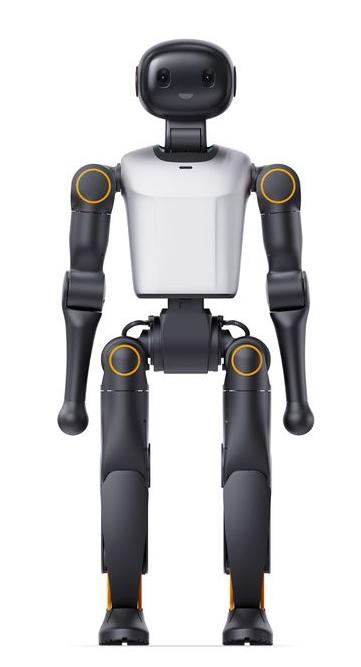
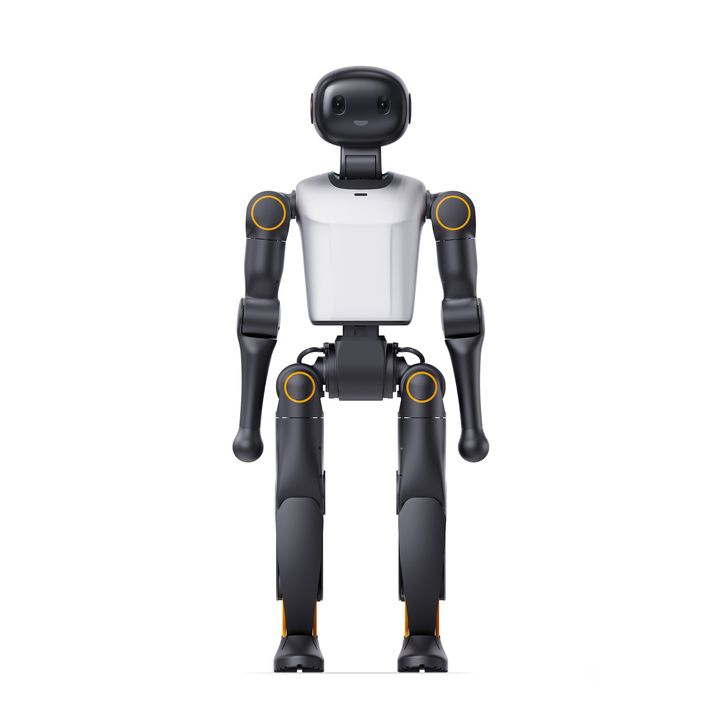
Booster K1 is a compact bipedal humanoid platform for robotics education, competitions and embodied AI development. It stands approximately 95 cm tall and weighs around 19.5 kg. The family comprises Geek, Education and Professional editions. All three share the same joint layout, while their onboard computers, memory, storage and batteries differ. This product page covers the K1 family, with the edition differences set out in the comparison below.
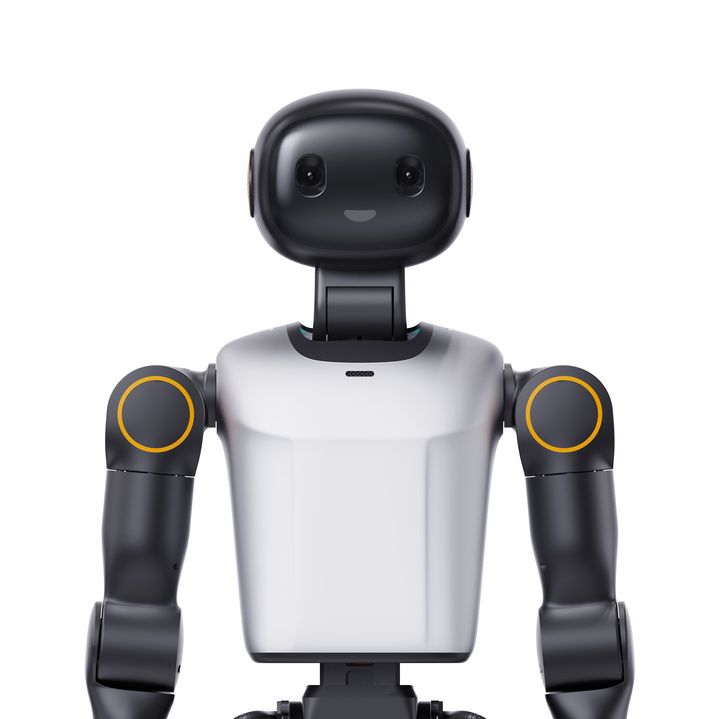
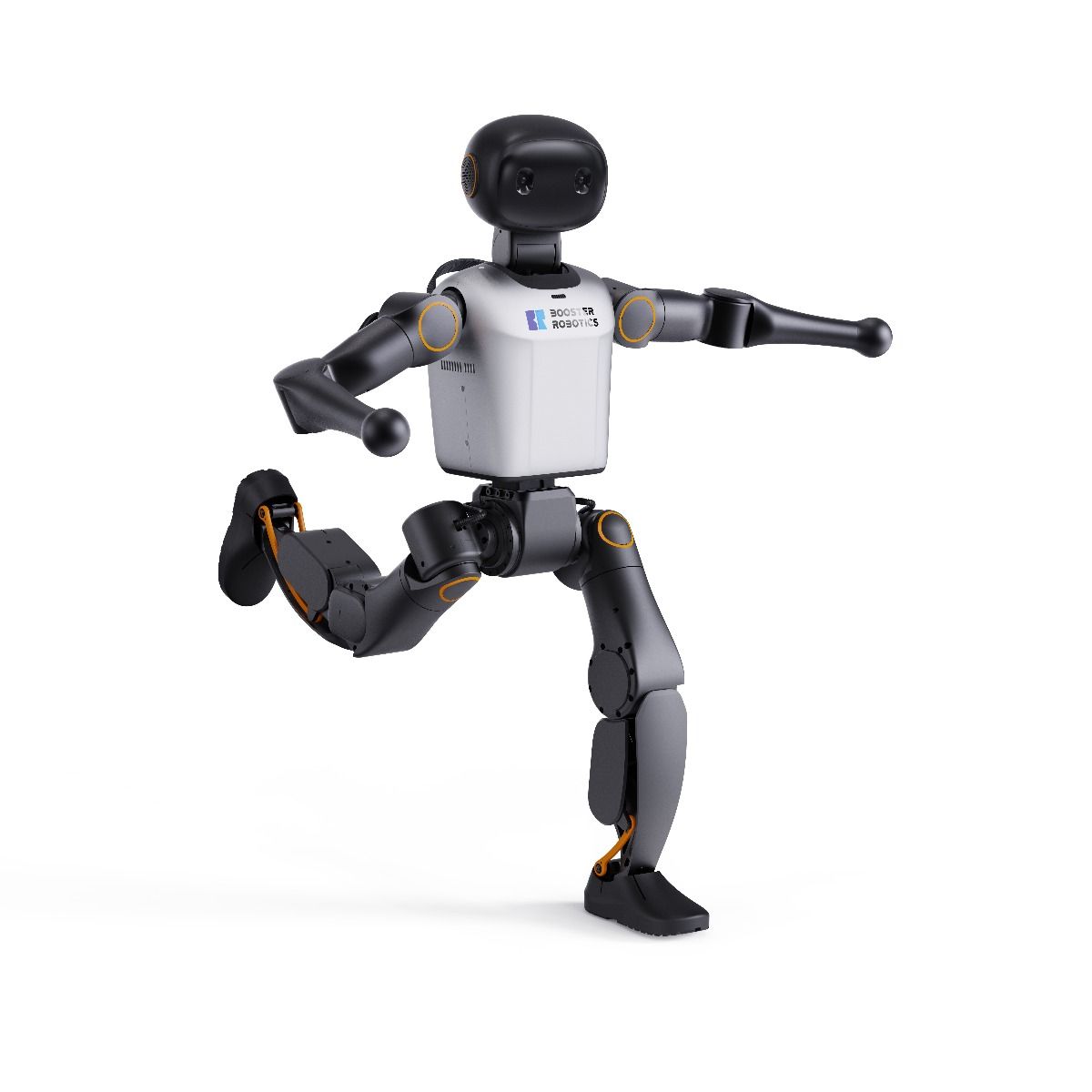
The robot has six degrees of freedom in each leg, four in each arm and two in the head. This arrangement supports work on bipedal locomotion, coordinated limb motion, head positioning and posture control. K1 can walk forwards, backwards and sideways, turn and combine different gaits. The depth camera and microphone array sit in the head; the controller, battery and speaker are housed in the torso.
The specified walking speed is 1.1 m/s for all three editions, with a turning speed of 1.5 rad/s. These are platform operating figures; the pace and route for a lesson or demonstration should suit the actual activity. A nine-axis IMU provides motion and orientation data, while the stereo depth camera supplies spatial information for perception tasks. The common mechanical layout allows teams to compare software behaviour across editions without changing the number of joints.
K1 includes software agents for basic gestures, football, conversation, motion teaching and dance. The basic agent performs greetings and other introductory actions. The football agent can track and chase a ball and perform kicks and shots. In Teach mode, the user physically guides a movement and the system recognises and reproduces the demonstrated sequence. The availability of an individual agent should be checked against the installed software release.
Secondary development is supported across all three editions. A teaching programme can start with existing behaviours before moving on to motion control and camera-based perception. Research teams can select an onboard computer according to the processing required by their own applications. This distinction matters when several AI models need to run together rather than when the task only uses a prepared movement sequence.
K1 models in URDF and XML formats and motion data are available through booster_assets. They support work on kinematics and the preparation of simulation experiments before testing on physical hardware. Comparing the planned trajectory with the real mechanism gives a team a practical way to examine how a motion sequence transfers to the robot.
Geek uses an ARM computing platform rated at 48 TOPS in Dense mode. Education moves to Jetson Orin NX 8GB, while Professional uses Jetson AGX Orin 32GB. TOPS figures describe the computing platform and do not guarantee a particular application frame rate. Neural network architecture, numerical precision and optimisation affect actual performance, so figures reported in different modes should not be treated as a direct multiplier of application speed.
| Parameter | Geek | Education | Professional |
|---|---|---|---|
| Height | ≈95 cm | ≈95 cm | ≈95 cm |
| Weight | ≈19.5 kg | ≈19.5 kg | ≈19.5 kg |
| Degrees of freedom | 22 | 22 | 22 |
| Computer | ARM | Jetson Orin NX | Jetson AGX Orin |
| AI performance | 48 TOPS Dense | 117 TOPS | 200 TOPS |
| Memory | 8 GB | 8 GB | 32 GB |
| Storage | 128 GB | 512 GB | 512 GB |
| Battery | 2 Ah | 5 Ah | 5 Ah |
| Walking at 1.1 m/s | 20 min | 70 min | 70 min |
| Charging | ≤2 h | ≤2 h | ≤2 h |
| Camera | Stereo depth | Stereo depth | Stereo depth |
| Connectivity | Ethernet, Wi-Fi, Bluetooth 5.2 | Ethernet, Wi-Fi, Bluetooth 5.2 | Ethernet, Wi-Fi, Bluetooth 5.2 |
| Development access | Supported | Supported | Supported |
At a walking speed of 1.1 m/s, the stated battery life is 20 minutes for Geek and 70 minutes for Education and Professional. These conditions are useful when planning a continuous walking session, but they do not define runtime for every dance routine or AI workload. Charging takes no more than two hours, so longer teaching schedules need to account for charging breaks.
Gigabit Ethernet provides a wired connection to a development workstation. Wireless options include Wi-Fi and Bluetooth 5.2. A microphone array and speaker support audio interaction, and the robot has one power button and three interaction buttons. Conversation software, language support and any required network services should be agreed for the intended deployment location, including projects in the UAE.
A laboratory or demonstration area needs clear space for movements, an operator and accessible stop controls. K1 can enter DAMP mode if it becomes uncontrollable, and a soft emergency stop can be triggered using the joystick, app or back-panel buttons. These functions support the operating procedure; the activity still needs a suitable supervised setup. When selecting a Booster K1 edition, define the required computing platform, session length and development workload first. Those requirements provide a practical basis for choosing Geek, Education or Professional.
Tell us about your task, site and robot. Leave your contact details so we can discuss the scope and next steps.