
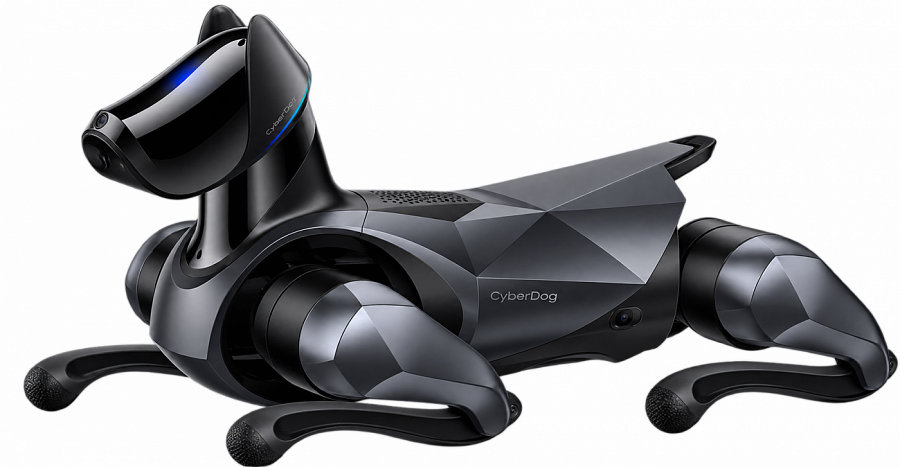
Xiaomi CyberDog 2
- Max payload
- 1 kg
- Mixed-cycle runtime
- ≈90 min
- Max speed
- 5.76 km/h


Price on request · Available to order
Xiaomi CyberOne is a full-size bipedal research platform introduced by Xiaomi Robotics Lab in 2022. It combines body control, Mi-Sense depth vision and audiovisual interaction. The platform presents Xiaomi's approach to humanoid robotics through mechanical actuation, spatial perception and software interpretation of the scene as parts of one system.
CyberOne has 21 degrees of freedom. Walking and gestures require coordinated actuators, body posture and balance. Arm movement is related to the state of the whole mechanism, while a step changes its support. The research problem therefore concerns coordinated changes throughout an action rather than only a trajectory for one joint.
The manufacturer describes programming by demonstration. This connects a shown movement with reproduction on the physical platform. A humanoid system must relate that example to its available joints and achievable body postures. The result depends on how software converts the example into actuator commands and coordinates them across the mechanism.
The in-house Mi-Sense depth module works with an interactive camera and three-dimensional reconstruction algorithms. This adds spatial geometry to the visual input rather than treating the surroundings only as a flat image. It provides a basis for observing surfaces and the placement of objects that may become relevant to a later robot action.
A research workflow can distinguish depth acquisition, interpretation of relevant scene elements and their connection to movement. Each stage affects the resulting behaviour. Three-dimensional reconstruction supplies a perception foundation, while a particular operation still needs its own definition and evaluation within the selected working scene.
Two microphones feed audio to MiAI algorithms. The manufacturer describes environmental-sound recognition and classification of vocal emotion. This provides a way for software to select a response to an observed audio context. A class produced by a model is an interpretation of a signal, used within the chosen interaction programme.
A curved OLED display provides visual feedback. Together with audio, it presents the robot's state or response to a person. This arrangement matters in an interaction demonstration because the observer receives an output that can be related to perception. The content and order of the response are defined in the software.
CyberOne is described as a published research platform with a specific combination of technologies. Its relevance lies in bringing bipedal mechanics, depth vision and multimodal interaction together. A practical application requires a defined environment, programme and evaluated outcome. For a UAE robotics or technology audience, the platform is a way to understand these research directions while keeping component capabilities distinct from a completed operational skill.
CyberOne stands 177 cm tall with a stated weight of 52 kg. Its full-size mechanism combines integrated shoulder movement, an elbow rotation motor and hidden wiring in the upper structure. A gesture consequently involves physical links as well as a visual or audio response. Coordinating those links with the body and legs connects the demonstrated interaction to the balance of the bipedal platform.
Tell us about your task, site and robot. Leave your contact details so we can discuss the scope and next steps.