

AheadForm Elf·Xuan
- Facial degrees of freedom
- >30
- Interaction
- Expressive facial movement
- Skin detail
- ≤0.5 mm

Price on request · Available to order
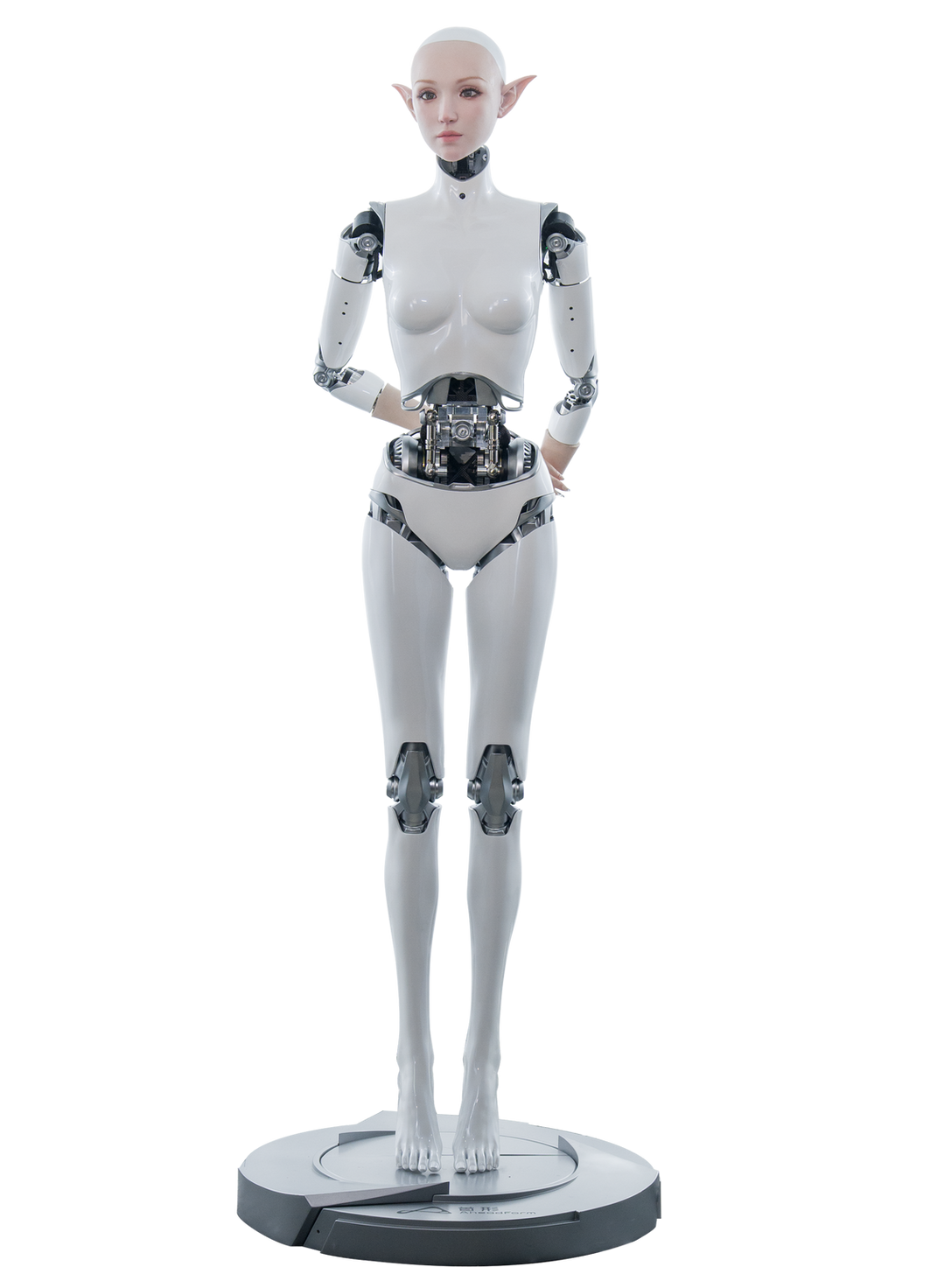
AheadForm Elf·Xuan 2.0 is an ELF-series bionic robot with a moving upper body. It extends Xuan's stylised elven character by adding torso and arm expression to head and facial performance. The format is relevant to stage scenes, exhibition programmes and branded sets where a character needs to respond through posture as well as its face. Its upper-body designation provides no basis for assuming independent walking.
The manufacturer identifies three independently controlled regions: the waist, upper arms and forearms. It also explicitly states that the wrists and shoulders are locked. Those qualifications belong together when planning a sequence. Three control regions do not mean three degrees of freedom for the entire robot, and arm movement does not establish independent control of the hands or fingers.
The Chinese description names waist rotation, upper-arm extension and forearm bending. These give a concrete starting point for discussing a theatrical gesture. Joint angles, speeds and a kinematic diagram are not published, so a precise path around scenery, a microphone or a prop needs to be demonstrated on the selected configuration. Raising an arm should not be presented as a promise to pick up an object: grasping functions and payload ratings are not specified.
AheadForm links torso motion with facial expression drivers, bringing the head, body and face into a common performance. The stated applications include singing, narrative scenes, spoken presentation and audience interaction. For a director, the relevant evaluation is a complete passage: when the character turns, where a gesture ends and how that movement aligns with a line of dialogue. This shows whether posture supports the intended meaning.
The in-house drive motors and joint modules are described as supporting repeated movements and long displays. AheadForm emphasises quiet operation, precision and repeatability without publishing numerical ratings. Mechanical sound still needs evaluation in a quiet room, at close audience distance or near a live microphone. A schedule of repeated appearances also needs an agreed duty cycle and breaks; the reference to long displays does not define an operating duration for every sequence.
The 2.0 page explicitly retains the earlier version's second-generation bionic skin and synchronisation of singing, expressions and mouth movement. Makeup, clothing, hairstyle and styling can be changed without rebuilding the core frame, according to AheadForm. This makes the appearance a separate part of planning for a character that joins different programmes, while the underlying mechanical format remains the basis of the installation.
The manufacturer does not publish a new total degree-of-freedom figure for 2.0. The original Xuan's more-than-30 figure describes the face and should not be used as a whole-robot total for the successor. Likewise, skin detail does not specify gesture positioning accuracy. The exterior remains an artistic elven design even when its skin and expression are lifelike. That distinction matters when a brief calls for a fantasy figure rather than a neutral human presenter.
Planning the installation requires dimensions, mass, support arrangements, electrical requirements and an arm movement envelope, which are absent from the open page. Performance control methods, supported languages and operator involvement also need confirmation. For an Arabic or English programme in the UAE, a useful demonstration would run the complete scene on 2.0 from its starting pose and back again. This examines the relationship between motion, dialogue and the available space instead of relying on an isolated close-up of the face.

Tell us about your task, site and robot. Leave your contact details so we can discuss the scope and next steps.