
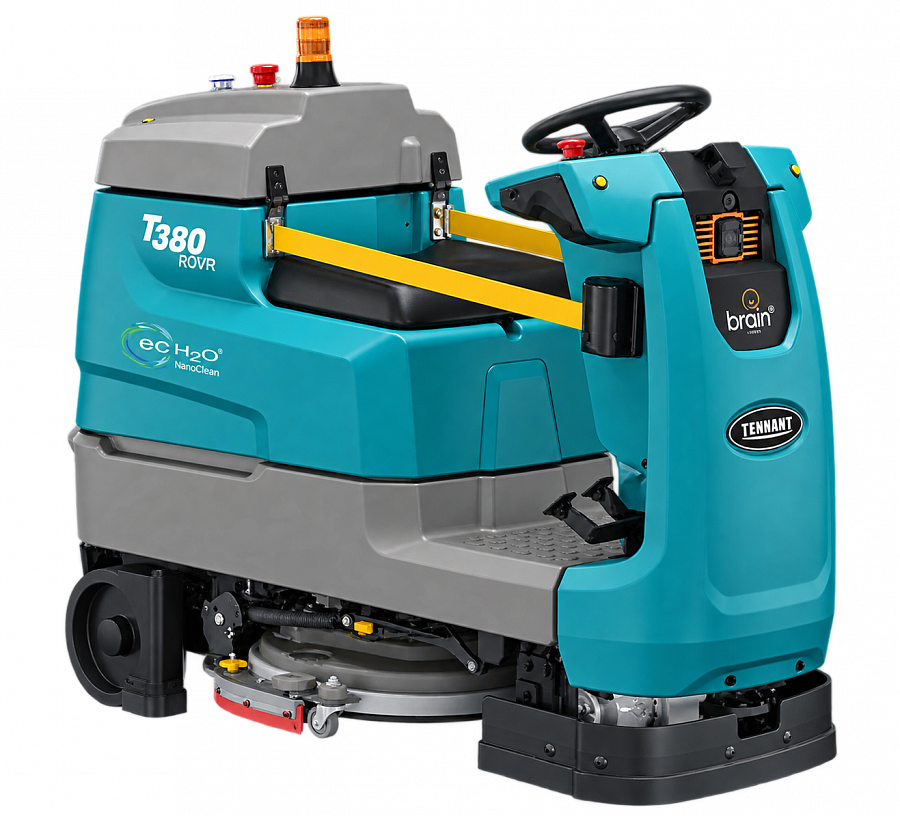
Tennant T380AMR
- Scrubbing (high-cap. Li-ion)
- ≤5 h
- Scrubbing width
- 500 mm
- Solution tank
- 75 L


Price on request · Available to order
Tennant T7AMR is a robotic disc floor scrubber for routine cleaning in commercial and public interiors. It is intended for hard floors and combines autonomous travel with a ride-on manual operating mode. The model is relevant where connected aisles and open areas need to be cleaned repeatedly as part of an established facility-care programme.
The cleaning path is 650 mm. A disc assembly provides mechanical floor treatment, while the recovery system collects used liquid. Separate solution and recovery tanks each hold 110 litres, supporting a sequence of cleaning areas before staff service the water system.
Scrubbing settings are selected for the finish and contamination involved. Optional ec-H2O NanoClean technology is intended to reduce water and detergent consumption in the corresponding configuration. Its operating characteristics should be associated with a machine equipped with that system. A site assessment can compare cleaning results and refill intervals in the selected mode.
BrainOS uses perception of the surroundings to control movement and avoid obstacles. Published materials describe taught repeatable routes as well as the current software platform with SelfPath AI. The available task-creation method depends on the selected machine's software and configuration, which is particularly relevant when assessing an earlier unit.
The working map connects routes to the actual layout. Replanning capabilities on the applicable platform help continue cleaning when an aisle is temporarily blocked. Areas should be chosen with furniture positions, usual pedestrian movements and staff interaction points in mind. This makes the route part of the building's practical operating pattern.
The operator position allows staff to drive the machine directly. This is useful for relocation to a service area, preparing work and handling particular movements. Repeated cleaning routes can be assigned to autonomous operation, while staff retain tasks that require checking the floor or responding to the situation.
Automatic braking and obstacle detection support motion control. Recovery performance also affects how the cleaned area can be used afterwards, making the condition of squeegee components and the recovery path an important part of day-to-day care.
Tennant offers flooded lead-acid and high-capacity lithium-ion battery options. Published upper runtime estimates are up to four hours and up to 6.5 hours respectively. The appropriate power arrangement depends on route duration, charging opportunities and the intervals needed to empty and refill the tanks.
A brush-wear indicator helps staff plan brush replacement. Fleet-usage reporting is available for monitoring cleaning activity across machines. Reports can help compare assigned work with actual use, while physical inspection remains the way to assess the resulting floor condition.
The T7AMR can be considered for retail, education, transport and other hard-floor environments. For a UAE facility, the assessment should include aisle width with the recovery assembly, turns and access to the service point. A trial covering the whole sequence from launch to preparation for the next task reveals how the 650 mm path, water capacity and selected battery fit the actual building layout. It also helps the team arrange autonomous work around the periods when different areas are occupied.

Tell us about your task, site and robot. Leave your contact details so we can discuss the scope and next steps.