
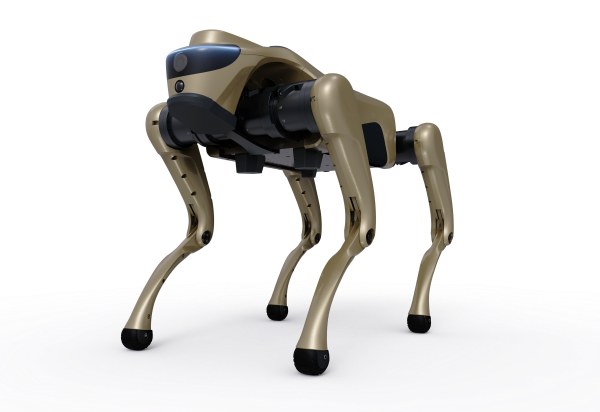
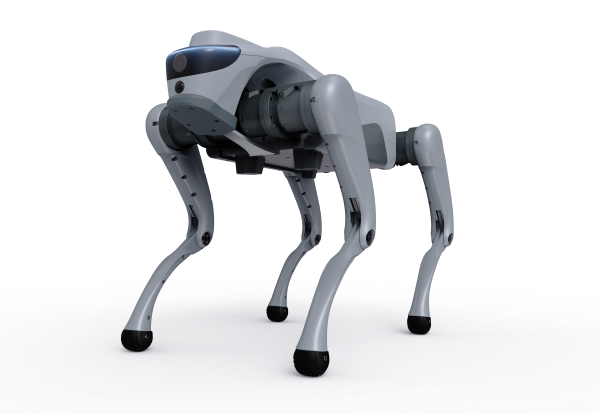
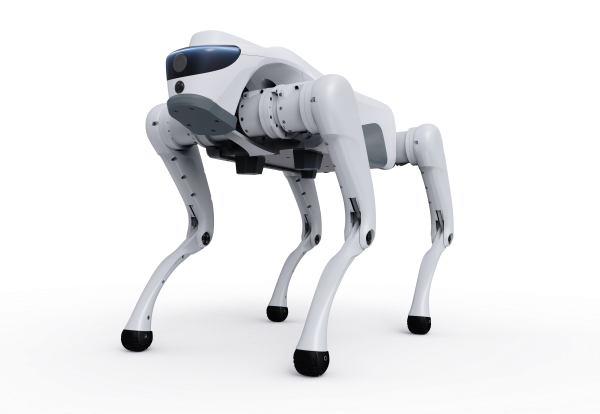
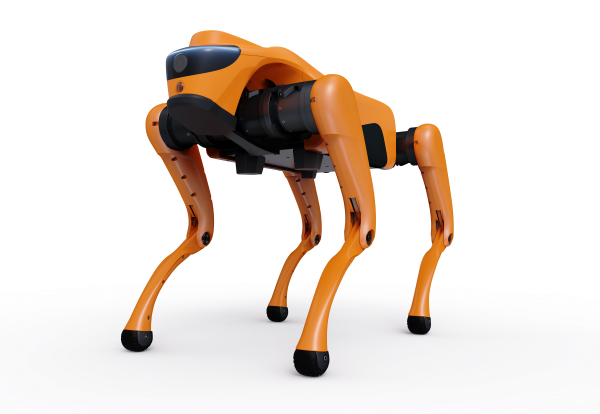
CyberStars Cyber1

- Payload
- 8 kg
- Family runtime
- ≈120–240 min
- Maximum speed
- 10.8 km/h
Price on request · Available to order
Description
CyberStars Cyber 1 is a quadruped robot platform for demonstrations, education and research. Its compact body combines twelve actuated degrees of freedom, a camera, connectivity and control through a transmitter or mobile application. The family includes Pro, Dev and Edu versions with different software capabilities and intended development roles.
Study movement through four articulated legs
The joint arrangement provides a physical way to examine how leg position relates to body motion and posture. In a demonstration, this can take the form of prepared actions. In development, it becomes a subject for programmed control and evaluation. The platform's size supports a defined workspace where movement can be observed, the result recorded and the next trial prepared.
The manufacturer describes walking, turning and demonstration movements. A practical programme follows the selected version and prepared working area. An educational activity can connect a particular action to its topic, such as command order, response to sensing or a change in pose. The robot then supplies an observable physical part of the exercise.
Select Pro, Dev or Edu for the task
Pro provides use of the available functions and controls. Dev is listed with secondary-development capability and an SDK. Edu is distinguished by research functions and reinforcement-learning support. These establish different software routes within the family, making the choice dependent on whether the team plans to use prepared behaviour or implement and evaluate its own logic.
A development task starts by establishing the interfaces and tools included with the selected version. An educational purchase can similarly be related to course content and the required level of control access. Hardware and software then match the experiment that participants are expected to carry out, giving the quadruped a practical role within the programme.
Use visual feedback and the control options
A wide-angle camera and ultrasonic sensor are listed for information about the surroundings. The handheld transmitter supports manual movement, and an app is available across the three versions. Visual remote control is an option. These channels allow a directly controlled demonstration or image-assisted operation in the relevant configuration.
For a custom application, the developer establishes which sensor information is used and how it affects an action. Perception, decision and movement can be tested separately to make each result understandable. Connecting them is particularly relevant when behaviour extends beyond a fixed prepared command sequence.
Plan the load and energy arrangement
The Pro, Dev and Edu family has a published payload of 8 kg, with the robot itself weighing 15.4 ± 0.5 kg including its battery. A computer or application module is assessed through its mass, mounting and effect on the balance of the complete assembly. Movement is then tested with the actual equipment installed, relating body motion and support coordination to that configuration.
The manufacturer distinguishes a standard 4800 mAh battery and a 9600 mAh long-endurance version. The Pro, Dev and Edu comparison table lists the 9600 mAh battery, so the actual battery is agreed for the selected configuration. Working duration is evaluated using the intended activity. Cyber 1 supports OTA updates and offers different levels of software access, from prepared demonstrations to development and research learning. A UAE team can match the version, battery and evaluation criterion to its intended experiment.
Available configurations
Specifications
Cyber1: Pro / Dev / Edu family
- Standing dimensions
- 67 × 36 × 43 cmAxis order unspecified
- Mass including battery
- 15.4 ± 0.5 kg
- Materials
- Aluminum alloy / engineering plastic
- Supply voltage
- 28–33.6 V
- Maximum working power
- 3000 W
- Payload
- 8 kg
- Maximum speed
- 10.8 km/hOriginally 3 m/s
- Climbing drop height
- 15 cm
- Maximum climbing slope
- 40 °
- CPU
- 8 cores
- Compute performance
- 6 TOPS
- Maximum joint torque
- ≈45 N·m
- Degrees of freedom
- 12 DOF
- Hip joint travel
- −30…30 °
- Thigh joint travel
- −25…204 °
- Lower-leg joint travel
- −114…17 °
- Camera
- Wide-angle
- Camera resolution
- 1920 × 1080 px
- Ultrasonic detection
- 4.5 m
- Bluetooth versions
- BT2.1+EDR / BT3.0 / BT4.2 / BLE4.2
- Wi-Fi band
- 2.4 GHz
- Cellular: product table
- 4GHomepage separately lists 5G; module configuration requires clarification
- Cellular: homepage
- 5GProduct table separately lists 4G; module configuration requires clarification
- Updates
- OTA
- Voice function
- Included
- Remote control
- Two-handed
- Visual remote control
- Optional
- App: Pro
- Included
- App: Dev
- Included
- App: Edu
- Included
- Dev: secondary development
- Included
- Dev: SDK
- Included
- Edu: research functions
- Included
- Edu: reinforcement learning
- Included
- Battery: product table
- 9600 mAhTable spans Pro/Dev/Edu; homepage identifies long-endurance variant
- Battery voltage
- 28.8 V9600 mAh variant
- Battery energy
- 276.48 Wh9600 mAh variant
- Standard battery
- 4800 mAh
- Long-endurance battery
- 9600 mAh
- Runtime
- ≈120–240 minFamily range; operating mode and battery mapping unspecified
- Charger voltage
- 33.6 V
- Charger current
- 5 A
- Colors
- Space White / Tech Gray / Champagne Gold / Vibrant Orange
- Battery management
- Automotive-grade BMS
- Demonstration movements
- Jumping and handstands
- Obstacle avoidance
- Using camera and ultrasonic sensing
- Country of origin
- China