

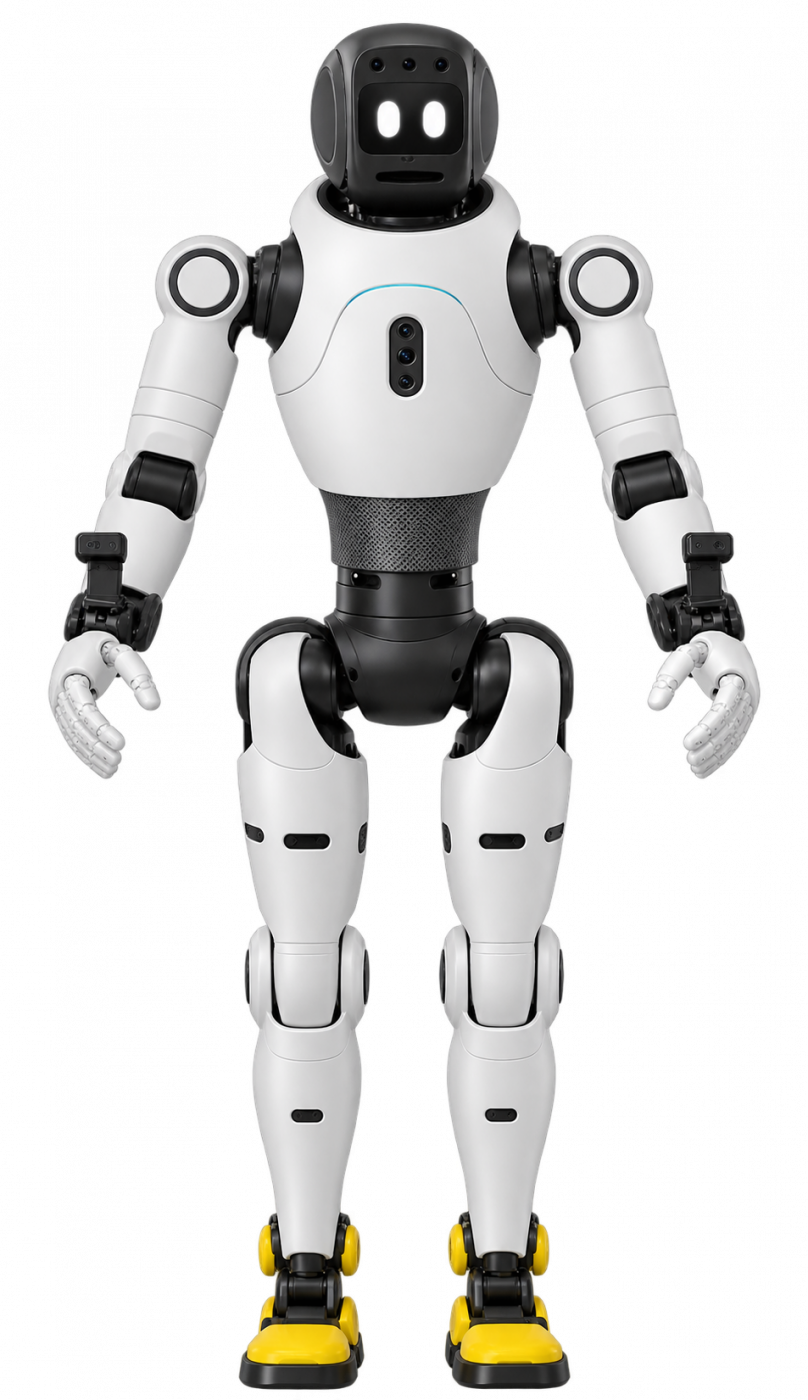
AGIBOT X2 Ultra
- Degrees of freedom
- 30 DoF
- Maximum speed
- 1.8 m/s
- Height
- 131 cm

Price on request · Available to order
AGIBOT X2 REC is a compact humanoid robot for data collection and embodied AI model development. It gives research teams a physical platform for recording demonstrations, teleoperation and evaluating learned behaviour. The REC configuration is intended for work that connects observations of the environment with whole-body movement and object manipulation, with development support extending beyond a prearranged performance.
X2 REC is positioned for collecting data in real environments, including retail, store and home scenarios. It supports single-person and multi-person task collection and multiple teleoperation modes. This makes it a candidate for laboratories building action demonstrations for training and then assessing the resulting behaviour on a physical robot. The research team still defines the task, objects, recording procedure and criteria for a successful attempt.
The manufacturer specifies a built-in whole-body motion control foundation model. This allows a research task to consider the coordinated posture of the body and limbs alongside an arm action. Before collecting demonstrations, teams should establish which movements the operator supplies, which observations are retained and how unsuccessful attempts are handled. These choices shape the dataset and its usefulness for learning; they are separate from the mechanical specification of the robot.
The REC sensor configuration includes an interactive RGB camera, a binocular RGB camera, a head RGB-D camera, a wrist RGB-D camera, a rear-view camera and LiDAR. Camera location matters when objects are being handled. A view from the head and a view close to the end effector observe the same action from different positions. Evaluating visibility throughout the intended arm movement is therefore more useful than comparing camera counts alone.
AGIBOT associates this multi-sensor arrangement with environmental understanding, motion recording, SLAM navigation and fine manipulation. These are development directions supported by the platform's perception equipment. A particular route or manipulation procedure still needs evaluation in its intended environment, including lighting, work-area geometry and object placement. The REC configuration lists an NVIDIA Orin NX module with 16 GB of memory for onboard computing.
OmniHand and OmniPicker are available as optional end effectors. Selection depends on the demonstrations the team needs to collect, from general grasping to more detailed manipulation and an expanded task set. The manufacturer describes support for multiple end-effector adaptations and collection arrangements with matching or differing operator and robot kinematics. The specific hand or gripper version and its control method should be identified as part of the project configuration.
An optional VR teleoperation package comprises a headset, controllers and a motion tracker kit. Full-body teleoperation provides a way to obtain demonstrations of coordinated actions from an operator. For a research programme, the relevant questions also include available recording channels, movement correspondence and repeatability of the collection procedure. The VR package is a separate configuration choice and should be confirmed alongside the robot and selected end effector.
X2 REC supports secondary development and is presented around a Collect-Train-Evaluate-Deploy workflow. AGIBOT specifies support for the SkillForge skill factory and an integrated VLA toolchain connecting data collection, training, simulation testing and deployment inference. These are distinct stages of a research project: acquiring physical demonstrations, preparing training material, evaluating behaviour and bringing the model into the target operating setup.
When defining the software package, teams should establish data access, export formats, training compute requirements and the deployment procedure. The presence of an onboard computing module does not determine the resources needed to train every model. Software access, included tools and the intended research pipeline need to align with the project, particularly when a team already has its own datasets or evaluation process.
AGIBOT X2 REC stands 131 cm tall and weighs 40 kg. It has 31 full-body degrees of freedom and seven degrees of freedom per arm. Its specified maximum walking speed is 2 m/s, while the maximum end-effector payload is 3 kg. The payload figure applies to the end effector; the intended posture, movement and chosen gripper still need to be considered when defining an experiment with a particular object.
The battery capacity is 500 Wh and standard battery life is listed as two hours. A collection session should be planned around its actual motion and sensing workload, with runtime assessed for the intended programme. Before selecting X2 REC, define the end effector, VR equipment, sensor data requirements and software tools. A clear collection task provides the basis for choosing the configuration and keeps REC's research role distinct within the X2 family.
| Parameter |  AGIBOT X2 Ultra 30 DoF |  AGIBOT X2 Edu |  AGIBOT X2 Neo |  AGIBOT X2 Rec |
|---|---|---|---|---|
| Main purpose | Interaction, development | Education, motion control | Performances, interaction | Data collection, AI research |
| Height | ≈131 cm | 131 / 130 cm* | 131 cm | 131 cm |
| Weight | ≈39 kg | 33 / 35 kg* | 35 kg | 40 kg |
| Body DoF | 30 | 29 | 30 | 31 |
| Neck / per arm, DoF | 1 / 7 | 0 / 7 | 1 / 7 | Neck unspecified / 7 |
| RGB cameras | Interaction + 2 front + rear | Not fitted as standard | Interactive | Interactive + binocular + rear |
| RGB-D and 3D LiDAR | Fitted | Not fitted as standard | Not fitted | Head and wrist RGB-D + LiDAR |
| Display, audio, head touch | Display, lighting, microphones, speakers, sensor | Not fitted as standard | Display, lighting, microphones, speaker, sensor | Confirm configuration |
| Base computers | RK3588S + RK3588 | RK3588 ×1 | RK3588 series; confirm assembly | Not specified |
| Development computer | Orin NX, 16 GB, 157 TOPS | External PC or computing pack | Not fitted | Orin NX, 16 GB |
| Connectivity | Wi-Fi, Bluetooth, 4G/5G | Wi-Fi, Bluetooth | Wi-Fi, Bluetooth, 4G/5G | Confirm configuration |
| Ethernet | 2 × RJ45 | 1 × RJ45 | Not fitted | Confirm configuration |
| Development | AimDK: motion, interaction, perception; supplied modules vary | Motion, joints, modes, upper body | Not supported | Supported; data collection and model training |
| LinkCraft | Supported | Not supported | Confirm configuration | Confirm configuration |
| End effectors | OmniPicker, OmniHand (optional) | Gripper control; no dexterous hands | Not specified | OmniHand, OmniPicker (optional) |
| VR teleoperation | Confirm for this version | Not specified | Not specified | Headset, controllers, tracker (optional) |
| Battery, Wh | ≈421 | 421* | 500 | 500 |
| Runtime | ≈2 h at 0.5 m/s | ≈2 h at 0.5 m/s | ≈2 h at 0.5 m/s | 2 h, standard figure |
* EDU dimensions and weight depend on configuration: approximately 131 cm / 33 kg, or 130 cm including a dummy head / 35 kg. The described EDU hardware uses a 421 Wh battery; agree the delivered configuration and fitted battery. Ultra here is the original 30-DoF version.


Tell us about your task, site and robot. Leave your contact details so we can discuss the scope and next steps.