

Noetix Hobbs W1
- Active DoF
- 54 DoF
- Height
- 170 cm
- Format
- Wheeled

Price on request · Available to order
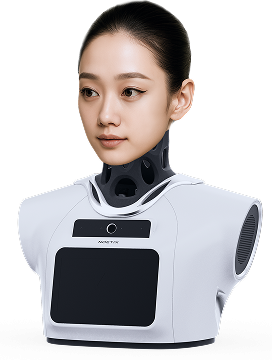
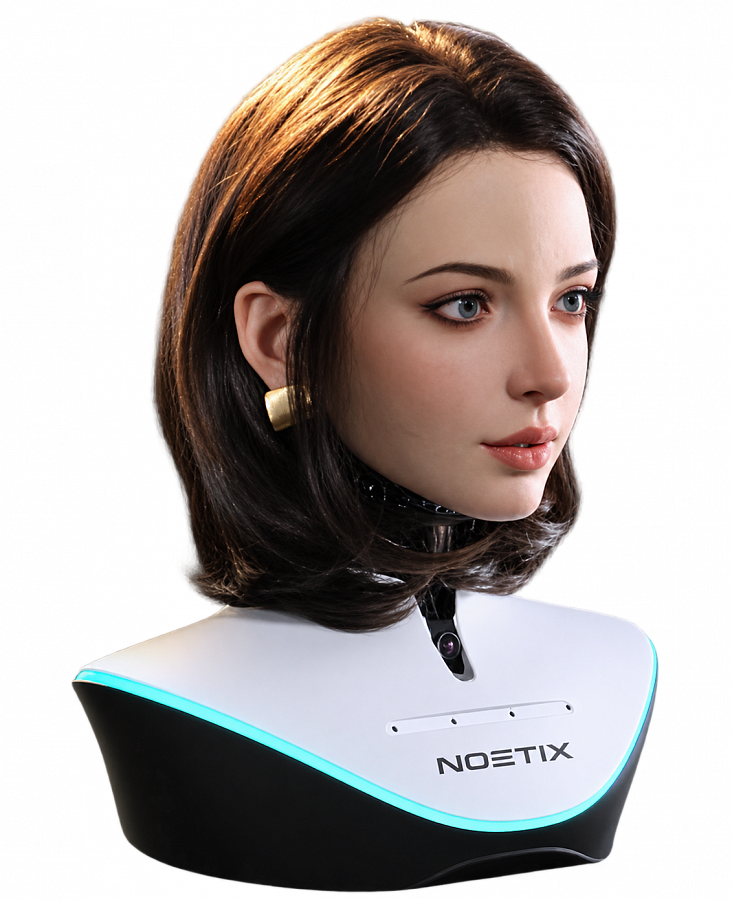
Noetix Xiao Nuo, formerly Hobbs 3, is a biomimetic bust for interactive systems where expressive facial movement matters. The 400 x 300 x 600 mm body weighs 10.5 kg; the head alone weighs 2.8 kg. Its fixed format can suit a reception demonstrator, research stand or installation built around a conversation scenario. It needs a stable mounting surface and power. The published configuration has no mobile chassis, so Xiao Nuo is designed as a stationary conversational presence rather than a robot that travels through a venue.
The head has 32 active and 8 passive degrees of freedom. Cable and linkage actuation drives the facial and neck mechanisms, while platinum silicone skin creates a lifelike surface. By moving facial elements, Xiao Nuo can show expressions such as smiling, surprise, sadness and displeasure. The 32 active degrees of freedom apply to the head; they are not the axis count of a complete humanoid robot. The manufacturer also describes the appearance as waxwork-grade.
The neck is specified for pitch of +/-27 degrees, roll of +/-25 degrees and yaw of +/-35 degrees. This range helps direct the head and gaze toward a conversation partner and position it within a display scene. Movement speed and duty cycle are not listed, so the intended interaction should be checked with the actual unit. The facial skin attaches magnetically and with snap fasteners and can be removed without damage. The manufacturer also offers hairstyle and makeup customization.
The system includes two RGB cameras in the eyes, a touch screen and another RGB camera in the body. Its audio equipment is listed as a linear microphone array and dual-channel speakers. Noetix describes environmental and contextual perception, voice interaction and lip synchronization with speech. This arrangement can support scenarios where the robot faces a visitor, responds with facial expressions and speaks. Recognition and audio quality depend on the installation conditions, including network quality and background noise.
The technical table lists latency below 1,200 ms for conversation and below 150 ms for facial expression. The manufacturer qualifies both values as dependent on actual network conditions. They help assess interaction responsiveness, while the complete response also depends on the cameras and microphones, network, server side and software. The public page does not name an AI model or supported languages; confirm those for the intended project.
The listed systems are Android and Ubuntu, with DC 48 V power, a serial port and Wi-Fi. Backend debugging and control of independent facial nodes are available for setup. The page also lists a cross-platform SDK and interfaces for motor control, facial generation and audio-driven lip synchronization. These give developers a basis for building an interactive application and adapting facial movement to a scenario. The interfaces do not mean that a finished application or integration with a buyer's system is included.
Before a project starts, confirm the software environment, connection methods, power, mounting and access to developer documentation. For visitor-facing use, define the interaction flow and the operating conditions for cameras and microphones. The public page does not state where audio or images are processed or stored, how long the unit can operate independently, or what maintenance it requires. These details depend on the supplied package and chosen software.
The manufacturer offers hairstyle and makeup customization, as well as changes to the appearance. The public specification table lists one Xiao Nuo version. X-Head1 Lite, X-Head1 and X-Head1 Ultra appear elsewhere in the same catalogue as a separate biomimetic-head family, so their specifications do not apply to Xiao Nuo. Confirm the desired appearance and package contents, then review the result under the lighting, viewing distance and acoustic conditions of the planned installation.
Xiao Nuo can be evaluated for an interactive reception stand, a research display, a speech-synchronization demonstration or development of a custom dialogue program. Project planning should cover a prepared installation, power and network access, software compatibility, required language, and camera and microphone placement.

Tell us about your task, site and robot. Leave your contact details so we can discuss the scope and next steps.