

AGIBOT X2 Ultra
- Degrees of freedom
- 30 DoF
- Maximum speed
- 1.8 m/s
- Height
- 131 cm

Price on request · Available to order
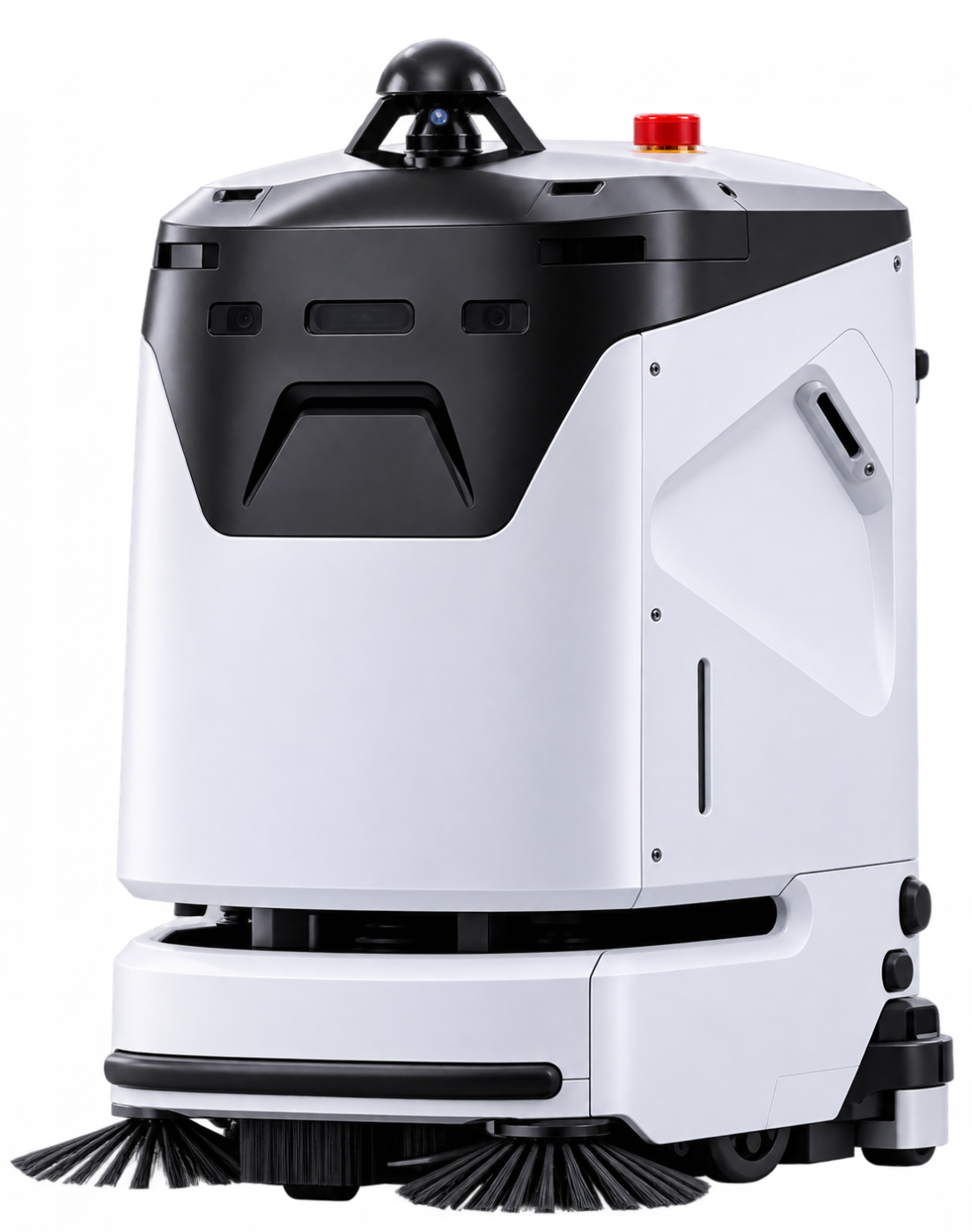
AGIBOT C4 is a commercial floor-cleaning robot for small-to-medium facilities with narrow aisles and changing layouts. The manufacturer names supermarkets, hotels, offices, showrooms, retail spaces, subway stations and factory warehouses as example settings. The machine combines sweeping, wet scrubbing and dry dust mopping.
C4 measures 680 × 510 × 1,015 mm and weighs 140 kg. It requires an aisle at least 600 mm wide and has an 800 mm turning radius. Obstacle clearance is up to 15 mm; gradeability is 5° under full load and 8° without load. These dimensions help assess access between shelves and through turning areas.
The front brush sweeps debris before the rear section scrubs the floor in the same pass. Dry dust mopping is available as a separate mode. C4's listed debris collection rate is 95%. The side brush gives a 600 mm cleaning width, roller-brush scrubbing width is 380 mm and the squeegee is 540 mm wide. Listed floors are epoxy flooring, marble, ceramic tile, emery and PVC.
The clean-water and dirty-water tanks each hold 25 L; the dustbin holds 1.6 L. Endurance is 3 hours for scrubbing and 8 hours for dry dust mopping. The battery is 24 V, 60 Ah, with a 1.5-hour charging time. Travel speed is 1.2 m/s and operating noise is below 65 dB(A).
The docking station automatically charges the robot, refills clean water, drains dirty water and adds detergent. The listed self-cleaning functions cover the roller brush, squeegee, dirty-water tank and station. Its water tank holds 4 L; clean-water refill is 5–8 L/min and drainage is 4–8 L/min. Maximum power of 1,200 W and rated input of 200–240 V apply to the station.
Navigation combines multi-line LiDAR and visual SLAM, with automatic map updates. Maximum cleaning efficiency is stated as up to 1,400 m²/h. Actual pace depends on route layout, obstacles and servicing, so facility planning should account for aisle geometry and docking-station placement.
AGIBOT states that C4 can self-diagnose more than 90% of faults. Alongside cleaning quality, this gives an operations team another point to assess during a demonstration: how an identified problem is displayed and what the operator needs to do next. Self-diagnosis and self-cleaning serve different purposes. One helps identify problems; the other services components that become dirty during use.
Select the work cycle around the floor-care task. In scrubbing mode, water is applied to the floor, the roller treats the surface and the squeegee collects water behind it. Dry dust mopping follows a different process and has its own endurance figure. A wet-cleaning schedule should therefore use the scrubbing specification, while a dry maintenance route can be assessed separately. The schedule also needs to accommodate returns to the station between routes.
C4 carries larger working water tanks than compact C2 and C2P: 25 L clean and 25 L dirty water, compared with 4 L and 3.5 L on those models. With its docking station, this makes C4 relevant to recurring floor scrubbing in retail and public spaces. Floor type and infrastructure also affect selection: C2 offers low-profile access beneath furniture, while C2P provides automatic roller lift on carpet and a mobile water-station option.


Tell us about your task, site and robot. Leave your contact details so we can discuss the scope and next steps.