
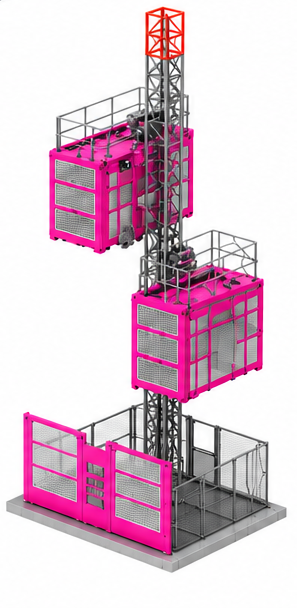
Intelligent Construction Hoist SC200/200ZA
- Rated capacity of two cages
- 2×2000 kg
- Maximum installation height
- 242 m
- Lifting speed
- 0–36 m/min

Price on request · Available to order
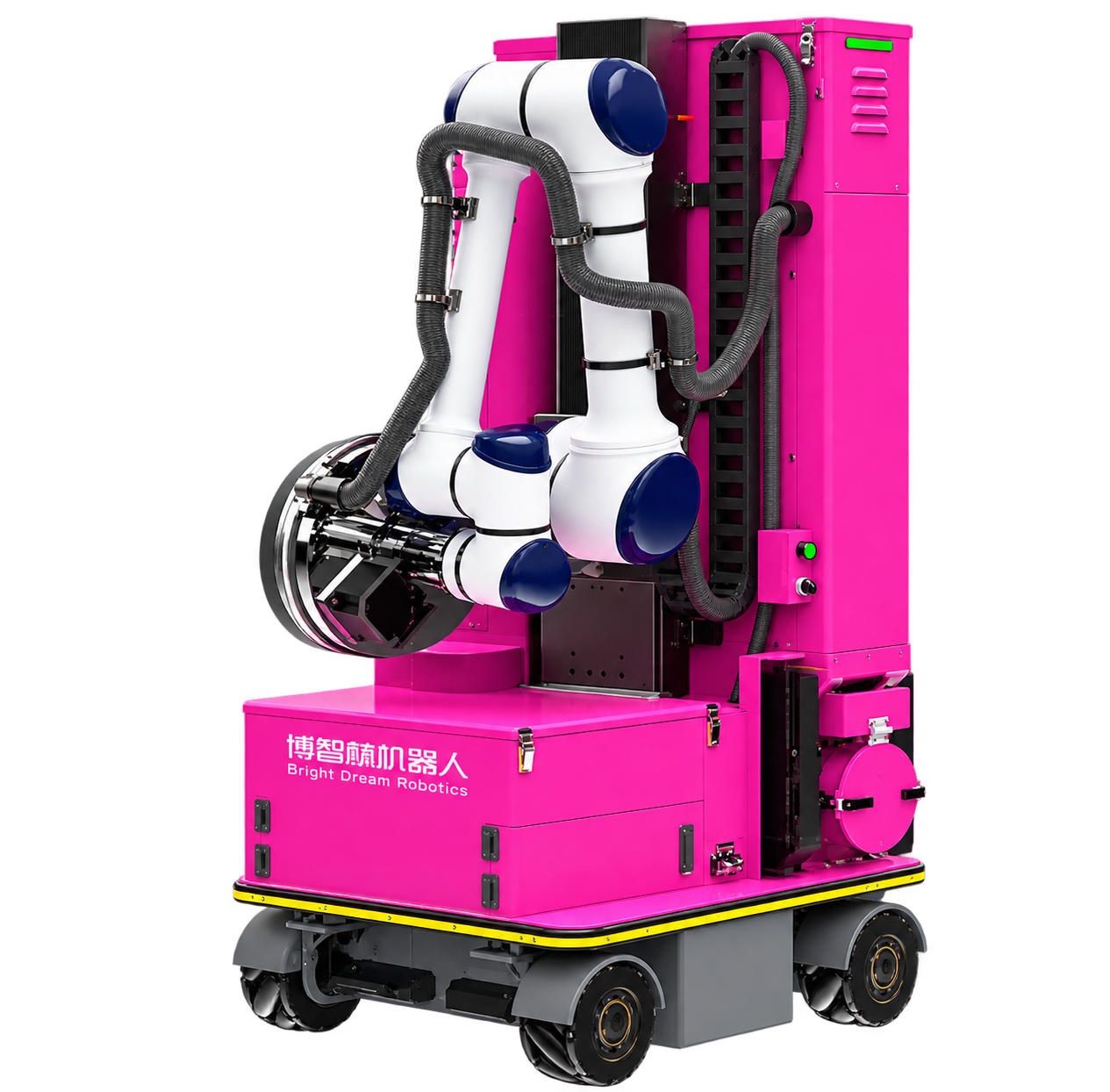
BMR Putty Grinding Robot is a mobile robot for grinding putty on interior walls and ceilings. It combines automatic travel and path planning with constant-force surface treatment. The model is intended for fine finishing and industrial decoration in residential buildings, houses, apartments, commercial premises and office buildings.
The machine's primary task is to treat an existing putty surface. Intelligent constant-force control manages contact between the working tool and the surface, while precise laser ranging supports the process. Parameterised grinding settings allow a working mode to be defined for the selected operation and repeated as different areas are processed.
Its main application is on interior walls and ceilings, and the brochure also illustrates bay-window grinding. Both machine position and the sequence of passes matter in these spaces. Automatic navigation and path planning connect the robot's movement with the area that needs treatment, supporting an organised surface-processing operation inside the building.
Vacuuming and dust collection are built into the robot's functions, with a 100 L dust collection box. These functions address the dust generated during mechanical surface treatment. The manufacturer also lists automatic putty discharge among the machine's material-handling capabilities, alongside the grinding and navigation systems.
Remote operation is available through an app. It provides a way to manage the robotised task while combining grinding settings with automatic travel. For an interior finishing area, the machine brings together contact treatment, movement and the handling of collected dust, rather than treating them as unrelated parts of the workflow.
The maximum working height is 3200 mm. The body measures 942 × 752 × 1750 mm in length, width and height, and total weight is 550 kg. Working height describes the available treatment reach; body dimensions describe the machine that must pass through and occupy the interior. Both are relevant when evaluating access and positioning at a project.
Positioning accuracy is specified as ±2 cm. This describes the robot's positioning and is considered alongside grinding settings and the geometry of the target area. Constant-force control and laser ranging address the surface-treatment process itself, supporting the controlled contact needed for grinding walls and overhead surfaces.
The manufacturer brochure gives overall construction efficiency as 50 m²/h. This figure is published as Bright Dream Robotics data for the grinding operation and can serve as a reference when comparing equipment with the intended task. The actual processing schedule also depends on material, surface condition and the work required in each interior.
Power supply requirements are specified as AC 220 V / 5 kW. Battery life is stated as at least 4 hours, with charging taking no more than 3 hours. Work-area planning therefore considers both the electrical supply requirement and the battery cycle, alongside the sequence of rooms and surfaces to be processed.
Maximum travel speed is 0.5 m/s. The specified limits are obstacles up to 20 mm high, trenches up to 50 mm wide and a climbing angle of up to 6°. They help assess an indoor route containing thresholds, floor-level changes or transitions between rooms before placing the machine in the work area.
This model addresses the grinding stage of interior putty finishing. Its defining functions are constant-force treatment, parameterised grinding, laser ranging and vacuum dust collection. Combined with working reach up to 3.2 m, those capabilities establish its role in processing walls, ceilings and accessible architectural areas within a building.

Tell us about your task, site and robot. Leave your contact details so we can discuss the scope and next steps.